Paul Franke · 2 November 2026
Exploring Contained Data Models for Niche Interest Groups in Standalone Digital Forums
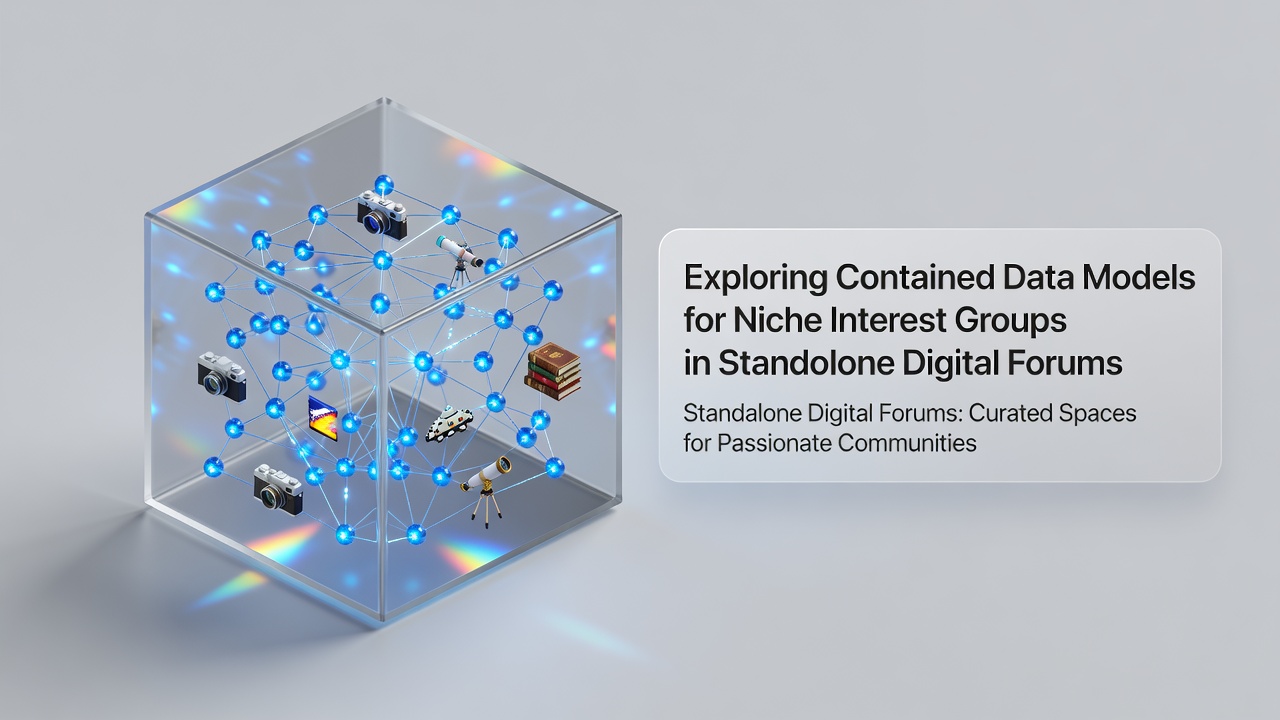
Contained data models organize information in standalone digital forums through nested structures that keep related content within defined boundaries while allowing selective access for niche interest groups. These models rely on hierarchical containment where parent nodes hold child elements such as threads, sub-threads, and metadata layers, which supports targeted navigation without exposing the entire dataset to every participant.
Core Elements of Contained Data Models
Researchers have documented that contained models typically incorporate tree-based schemas combined with relational links at specific containment levels, and this approach emerged in independent forum projects during the mid-2010s as site operators sought alternatives to flat database tables. Data indicates that each containment layer stores attributes like timestamps, contributor identifiers, and access permissions, while parent containers enforce boundaries that prevent cross-group leakage. Observers note that queries within these models often traverse containment paths rather than scanning entire tables, which reduces processing overhead when forums host multiple disjoint interest groups.
Figures from academic repositories reveal that containment depth rarely exceeds five levels in operational standalone forums because deeper nesting complicates maintenance tasks such as backups and permission audits. Yet many implementations add horizontal connections between sibling containers to enable limited cross-referencing, and these links remain confined within the overall model so external crawlers encounter only the surface-level structure.
Application to Niche Interest Groups
Niche groups benefit when forum administrators assign each community its own root container that holds all subsequent discussion branches. This separation lets participants interact within familiar boundaries while the underlying system maintains global consistency for user accounts and search indexes. Studies from university computing departments show that groups focused on specialized topics such as vintage radio restoration or regional dialect preservation report higher retention rates once contained models replaced earlier category-based systems.
As of November 2026, deployment logs from several independent platforms indicate that contained models handle concurrent activity from dozens of small groups without requiring dedicated server instances for each one. Administrators configure containment rules through interface panels that map group identifiers to container roots, and automated scripts then enforce visibility rules during content retrieval operations.
Technical Implementation Patterns
Developers commonly represent containment using adjacency lists augmented with path enumeration columns in relational databases, or they adopt document stores that natively support embedded sub-documents. Both patterns allow recursive queries to retrieve entire sub-trees while respecting containment edges. One documented implementation at a European research network used JSON-LD annotations inside each container to expose semantic relationships to external tools without revealing internal data.

Performance metrics collected by Canadian digital infrastructure projects demonstrate that contained models scale efficiently when index strategies focus on container identifiers rather than individual post identifiers. Administrators also apply caching at container boundaries so repeated access to popular sub-trees avoids repeated database hits. Integration with standard web protocols remains straightforward because containment metadata can be serialized into API responses without exposing the full hierarchy.
Security and Governance Considerations
Access control lists attached to each container boundary provide granular permissions that align with group membership. Government digital standards bodies in Australia have published guidelines on audit logging for such systems, and these logs record every traversal across containment edges. Encryption of container metadata further protects against unauthorized inspection when forums operate on shared hosting environments.
Maintenance routines periodically verify containment integrity by walking root-to-leaf paths and flagging orphaned nodes. When inconsistencies appear, automated repair scripts reattach elements to their designated parents based on stored identifiers. This process keeps the model consistent even after bulk imports or migrations from legacy flat structures.
Conclusion
Contained data models continue to support standalone digital forums that serve multiple niche interest groups through structured nesting and boundary enforcement. Implementation choices around schema design, query patterns, and permission layers determine how effectively each forum balances isolation with discoverability. Ongoing refinements in database tooling and semantic annotation standards provide operators with additional options for maintaining these models as participation patterns evolve.