Freya Patterson · 19 October 2026
Nested Branching Frameworks for Self-Run Online Discussion Hubs
Self-run online discussion hubs rely on structured systems that organize conversations into expandable layers, and nested branching frameworks provide the technical backbone for this approach by allowing threads to divide into sub-threads while maintaining clear connections back to the original topic. These frameworks operate through recursive data models where each post can contain child posts, and those child posts can themselves branch further without flattening the overall hierarchy. Developers implement this using tree data structures in databases, often with adjacency lists or nested set models that track parent-child relationships across potentially thousands of entries.
Core Mechanics of Branching Systems
Implementation starts with a central node representing the main discussion, after which replies attach as direct children and subsequent responses attach to those children in turn, creating depth that mirrors real conversational progression. Database queries traverse these relationships using recursive common table expressions in SQL environments, while front-end rendering uses indentation or collapsible sections to display the resulting structure to users. Software such as custom forks of existing forum engines incorporate these patterns by extending core post tables with foreign keys that reference parent identifiers, and this setup supports self-hosted installations on standard web servers without external dependencies.
October 2026 brought updates to several open-source libraries that simplified the handling of deep nesting limits, with patches addressing performance bottlenecks that previously caused slowdowns when thread depth exceeded fifteen levels. Those updates included optimized indexing strategies that reduced query times by measurable margins according to benchmark reports from development communities.
Information Organization Patterns
Observers note that effective frameworks separate content into primary categories at the top level while permitting granular branching within each category, which prevents the common issue of linear post lists that bury older contributions. Moderation tools integrate directly with the branching logic so that administrators can lock specific sub-branches without affecting the entire thread, and permission systems assign roles at different depths rather than applying uniform rules across the hub. This layered permission model draws from established information architecture principles documented in research from the University of Toronto's digital media studies group.
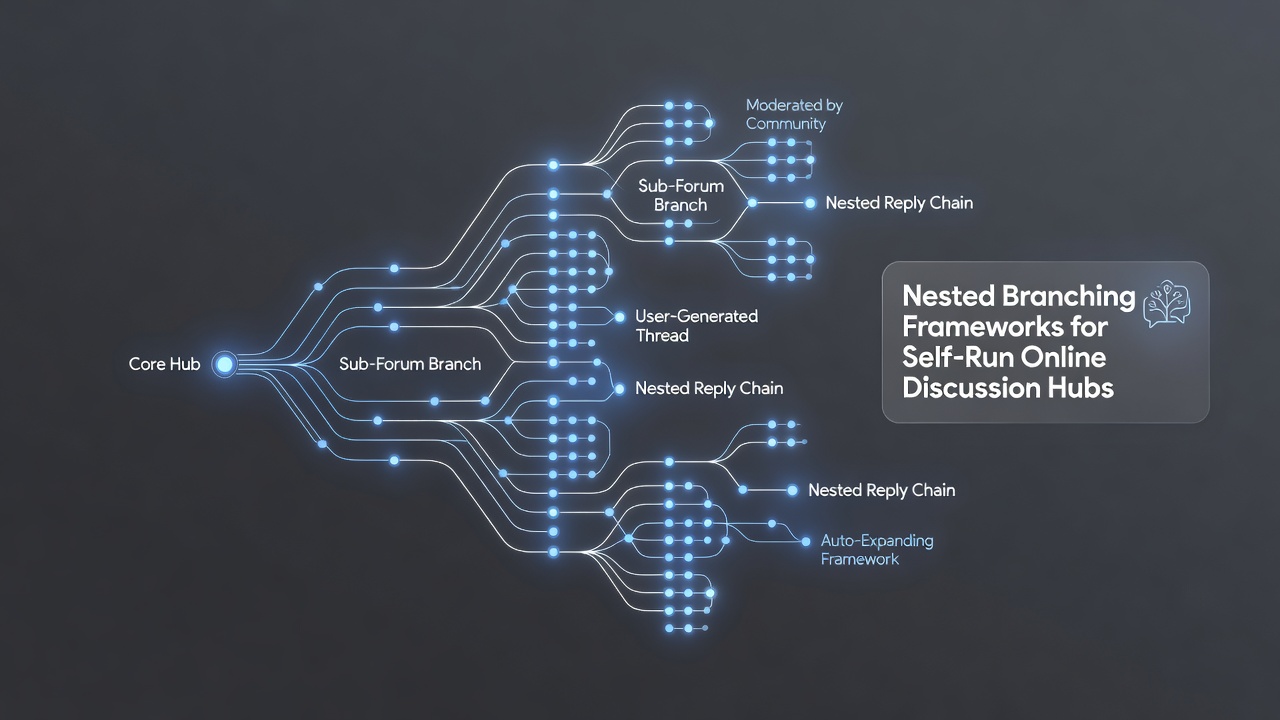
Data from server logs across multiple independent installations shows that users engage more consistently when they can follow specific branches rather than scrolling through undifferentiated replies, and retention metrics improve when the interface reveals context through visual nesting cues. Australian research institutions have published similar findings in studies examining community platforms, highlighting how recursive structures align with natural topic exploration behaviors.
Technical Implementation Considerations
Developers building these systems on self-hosted infrastructure select storage backends that handle hierarchical data efficiently, with options including graph databases for complex relationship mapping or relational systems augmented with materialized path columns for faster retrieval. Caching layers store pre-computed branch views to minimize repeated traversals during high-traffic periods, and API endpoints expose branch data in JSON formats that client applications consume for dynamic loading. Security practices require sanitization at each nesting level to block injection attempts that could propagate through child posts, while rate limiting applies per branch to prevent targeted overloads.
Integration with search functions demands specialized indexing that accounts for branch position, since standard full-text search often fails to surface context from deeply nested replies. Solutions combine keyword matching with path metadata so that results display the full ancestry chain, allowing participants to understand where a contribution sits within the larger conversation tree.
Scalability and Maintenance Factors
Self-run hubs using nested branching encounter scaling challenges once participant numbers grow, yet solutions such as sharding by top-level category keep individual branch queries contained within manageable datasets. Regular maintenance scripts prune empty branches and archive stale sub-threads, preserving performance while retaining historical context through exportable formats. Monitoring tools track branch depth distribution and alert operators when certain topics risk exceeding practical nesting thresholds, prompting manual review or automatic flattening suggestions.
Conclusion
Nested branching frameworks continue to shape how independent operators structure their discussion platforms by providing systematic ways to contain expanding conversations within coherent hierarchies. Implementation draws on established database techniques and benefits from ongoing refinements in open-source tooling, with adoption patterns reflecting the needs of communities that prioritize self-management over centralized services.